Buyer's guide
Can an AI Receptionist Handle Emergency Calls?

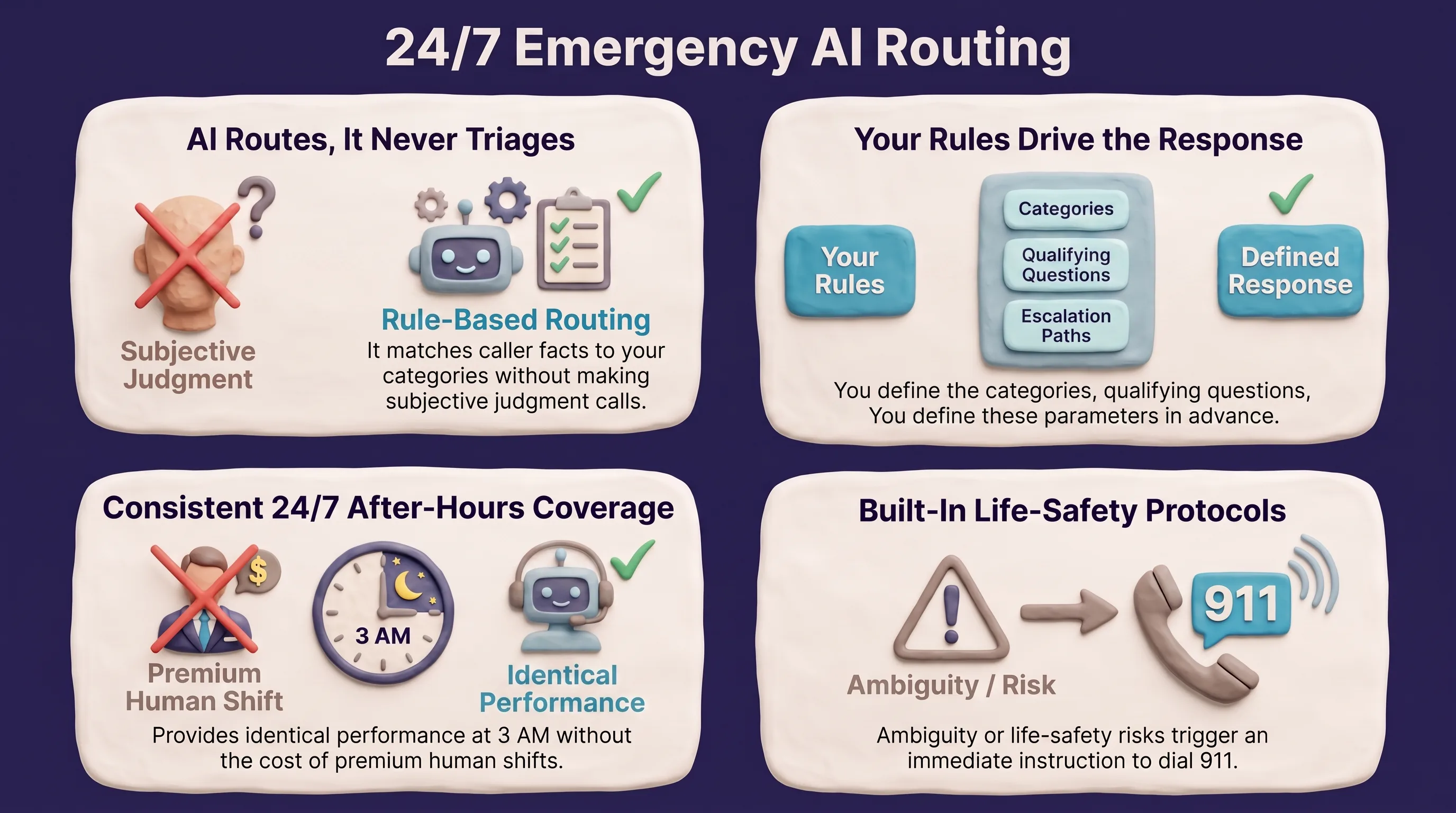
Yes — an AI receptionist can handle emergency calls, and for most service businesses it handles them better at 2 a.m. than a voicemail box or an overseas call center does. The critical distinction: the AI does not decide what counts as an emergency. You do, in advance. The AI asks the questions you wrote, classifies the call against your categories, and escalates the way you told it to — warm transfer to the on-call tech, blast the emergency line, or instruct the caller to hang up and dial 911. Urgency is routed by your rules, every single time, with no judgment call and no bad night shift.
That last part is the actual advantage. A human answering service is a person making a decision at 3 a.m. on their sixth hour. Rule-based routing is boring, repeatable, and identical on call one and call four hundred.
What “routed by your rules” actually means
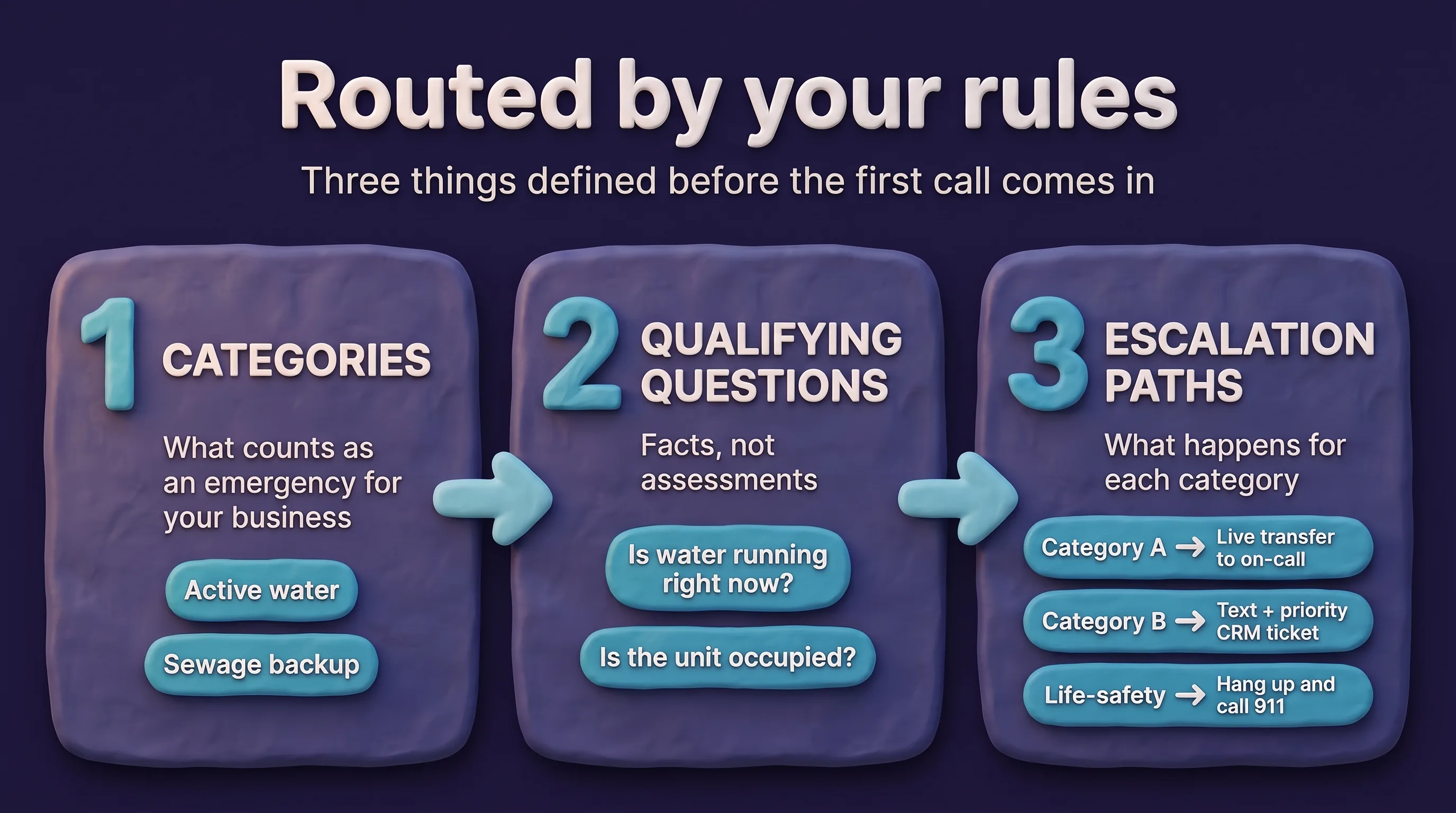
Every emergency answering service — human or AI — needs the same three things defined before the first call comes in:
1. Categories. What counts as an emergency for your business? For a plumber, that might be active water, sewage backup, or no water at all. For an HVAC company in July, it might be no cooling with a vulnerable occupant in the home. For a property manager, it might be a lockout, a gas smell, or a unit with no heat. These are your definitions, written down, in the script.
2. Qualifying questions. The short list the AI asks to slot the call into a category. “Is water actively running right now?” “Have you been able to shut off the main?” “Is the unit occupied?” Facts, not assessments. The AI collects; it does not evaluate.
3. Escalation paths. What happens for each category. Category A gets a live transfer to the on-call phone. Category B gets a text plus a priority ticket in the CRM. Category C gets booked as the first slot tomorrow morning. Life-safety gets a single instruction: hang up and call 911.
Once those three exist, “can the AI handle emergencies” stops being a question about AI capability. It becomes a question about whether your rules are any good — which is a question you already had, and were probably answering inconsistently.
The AI does not triage. It routes.
This deserves to be blunt, because the industry uses “triage” loosely and it matters.
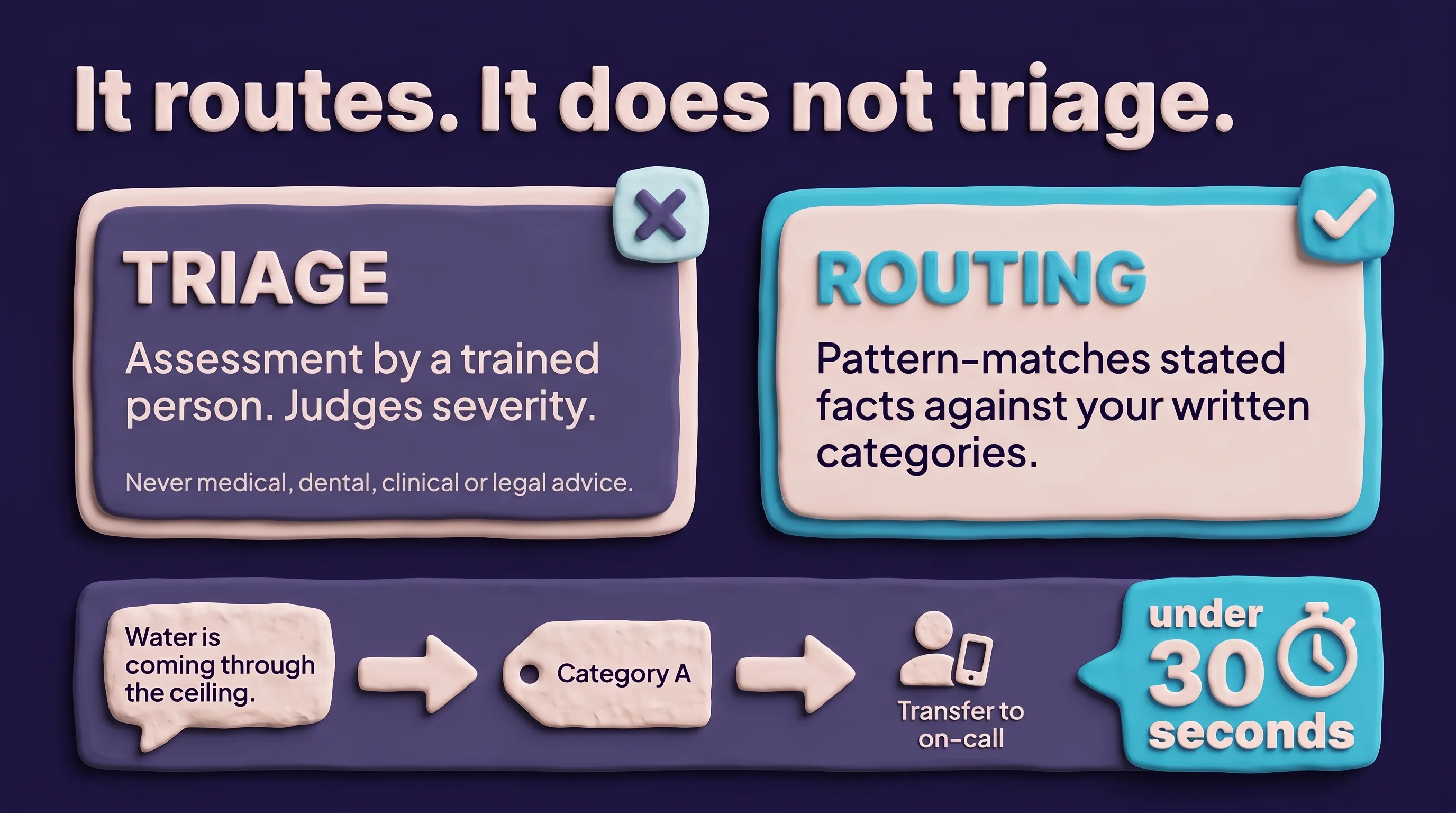
Triage, properly, is assessment — someone with training judging severity. A CallNeo receptionist does none of that. It does not tell a caller whether a chest pain is serious, whether a smell is dangerous, whether a fall needs an X-ray, or whether a lease clause is enforceable. It does not give medical, dental, clinical, or legal advice of any kind, and it is built not to attempt it even when a caller pushes.
What it does is pattern-match stated facts against your written categories. The caller says water is coming through the ceiling. That phrase maps to your Category A. Category A means transfer to the on-call number. Done in under thirty seconds.
If a caller describes something outside your categories — anything ambiguous, anything that smells like a life-safety event — the correct script behavior is to escalate up, not sideways: instruct 911 where appropriate, and get a human on the line otherwise. Ambiguity always resolves toward a person. That is a design choice you should insist on from any vendor.
Why after-hours is where the money actually is
There is a well-worn statistic floating around the answering-service world claiming 85% of callers never call back after a missed call. We have gone looking for the source and cannot find one — nobody who cites it can either. Treat it as folklore, not data.
You do not need a fake number to justify emergency call coverage. Run your own: pull your carrier’s call log for the last ninety days, filter to calls outside business hours, and count the ones that got no callback and no job. Multiply by your close rate and your average ticket. That figure is real and it is yours. Our missed-call revenue calculator will do the arithmetic if you want it faster, and we go deeper on the methodology in what missed calls actually cost a home-service business.
The pattern most owners find is the same: emergency calls are the highest-ticket calls they take, and they are disproportionately the calls that hit voicemail. Nobody calls a plumber at 11 p.m. to ask about faucet finishes.
What an emergency call answering service costs
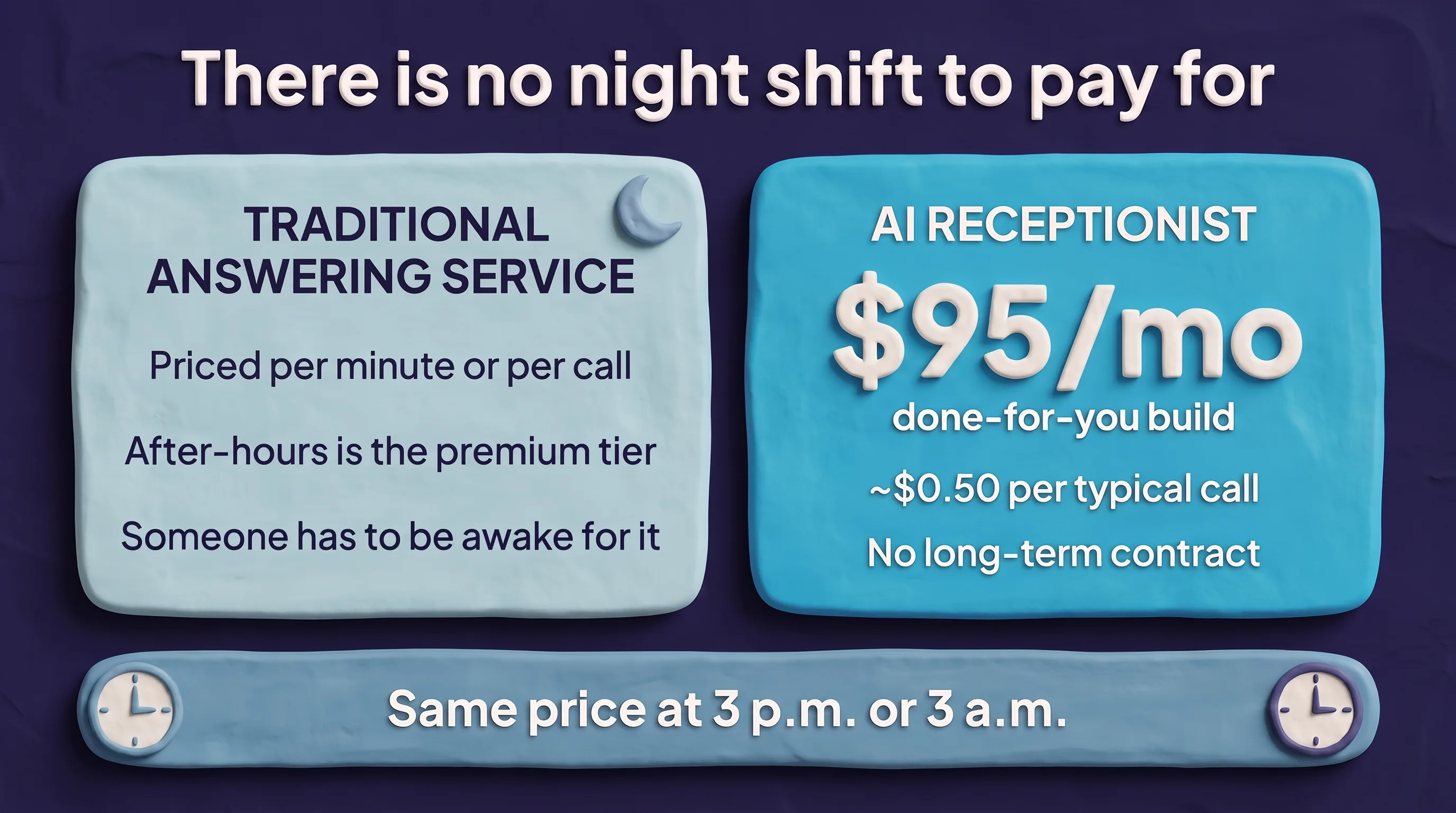
Traditional emergency phone answering services price per minute or per call, and after-hours is usually the premium tier. That is the structure — an emergency at 3 a.m. costs more than a booking inquiry at 3 p.m., because someone had to be awake for it.
An AI receptionist does not have a night shift, so there is no night premium. CallNeo starts at $95/mo for a done-for-you build, and overage works out to roughly $0.50 for a typical call whether that call lands at noon or at four in the morning. There is no long-term contract. We break the full pricing model down in our AI receptionist cost guide, and if you are comparing against a human-plus-AI hybrid, our Smith.ai comparison covers where each model genuinely wins.
To concede the honest point: a skilled human answering service handles the weird call better. The caller who is panicking and incoherent, the situation nobody wrote a category for, the person who needs to be talked down before they can give an address — a good human agent is better at that, and it is not close. The counter-argument is consistency and cost. Humans are better on the outlier; rules are better on the other ninety-five calls, and they never call in sick on Christmas Eve. Many businesses run the AI as the front door with a human escalation path behind it, which is the best of both.
The three trades where emergency routing pays for itself
Plumbing. The classic emergency answering service use case. Burst lines, backups, and water heaters do not respect business hours, and the caller is standing in an inch of water while they dial. Speed of answer beats polish. See our plumbing page for how the routing is typically structured.
HVAC. Seasonal spikes are the problem. The first hot week of summer generates more calls in three days than the previous three weeks combined, and a human answering service that was adequate in April is drowning by June. Capacity does not degrade under volume with an AI — the four hundredth call gets the same script as the first. More on HVAC setups here.
Property management. The hardest of the three, because the rules are the most granular. Different escalation paths per property, per owner, per lease. Lockouts route one way, no-heat another, a smell of gas straight to 911. A well-built AI receptionist holds all of that without confusing Building 4 with Building 9. See property management.
What a good emergency script looks like in practice
Short. Specific. Non-negotiable at the edges.
- Open with the escalation question, not the sales question. Emergency calls should be identified in the first fifteen seconds, before name, before address, before anything else.
- Ask facts, not judgments. “Is water running right now” — not “how bad is it.”
- Name the fallback chain. Primary on-call, then secondary, then owner. Ring counts specified. No dead ends.
- Hardcode the 911 instruction. Gas, fire, smoke, injury, anyone in danger: end the call, dial 911. No qualification, no follow-up questions, no attempt to assess.
- Log everything. Every emergency call should hit your CRM as a timestamped record with the answers to every qualifying question. CallNeo integrates with any CRM that has an API, so the record lands where your team already looks.
For healthcare clients specifically: CallNeo runs HIPAA-compliant infrastructure and signs BAAs. Worth saying plainly, since the industry is sloppy about it — there is no such thing as being “HIPAA certified,” and any vendor claiming that badge is telling you something about their diligence. Urgency in a clinical setting still routes by the practice’s own protocol: the on-call provider, the answering line, or 911. The AI never assesses a symptom.
How long it takes to stand this up
Most CallNeo businesses go live in about 48 hours on the Starter plan. Emergency routing does not extend that much, because the bottleneck is not technical — it is you deciding what your categories are. Owners who already have an after-hours protocol on paper are the fastest. Owners who have been improvising it are slower, and honestly, the exercise of writing it down is worth doing regardless of who ends up answering the phone.
We write the script, train it on your business, connect your tools, and keep optimizing after launch. You only go live once the emergency path has been tested and you have signed off on it.
Want to hear how it handles a call before you commit? Call the demo line and try to break the escalation logic — describe an urgent situation and see where it sends you. If you would rather talk through your specific routing rules with a human first, book a demo and we will map the categories with you.
Frequently asked questions
Can an AI receptionist handle emergency calls?
Yes, provided the emergency path is defined in advance by the business. The AI asks the qualifying questions you specify, classifies the call against your own rules, and then escalates — a warm transfer to the on-call tech, a text and phone blast to the emergency line, or an instruction to hang up and dial 911. The AI does not decide what counts as an emergency; you do, and it follows that script every time.
Does an AI receptionist do triage?
Not in any clinical sense. A properly built AI receptionist performs rule-based routing, not assessment. It collects the facts you told it to collect and matches them against the categories you defined. It never evaluates symptoms, never offers medical or legal guidance, and never tells a caller whether a situation is safe.
What happens if the on-call technician does not answer?
That fallback belongs in your escalation rules. A typical setup tries the primary on-call number, waits a set number of rings, then rolls to a second number, then a third, and finally sends a high-priority text or CRM alert to the owner. The AI keeps working through the chain because it does not get discouraged or forget step four.
Is an AI receptionist a replacement for 911?
No. For gas smells, fire, injury, or any life-safety situation, the correct script instruction is to end the call and dial 911 immediately. An AI receptionist is an emergency answering service for your business — dispatching your after-hours crew — not an emergency service.
How fast can an emergency answering service be set up?
Most CallNeo businesses are live in about 48 hours on the Starter plan, and that includes writing the escalation rules. The build is done for you, and you only go live once it is ready and you have signed off on the emergency path.
Does the caller get a confirmation after an emergency call?
On a live CallNeo build, confirmations and notifications are configured to whatever your workflow needs — texts to the on-call tech, a CRM record, an owner alert. What the caller hears is whatever your script says, which for emergencies is usually a clear statement of who is being contacted and what happens next.
See CallNeo answer your calls
Book a 15-minute demo and hear exactly how CallNeo would handle your phones.