Buyer's guide
Legal Answering Service: What Law Firms Should Look For

A good legal answering service answers every call, captures the same six intake details each time, books the consult, and never gives legal advice. The cost range is wide. CallNeo, an AI receptionist built for you, starts at $95/mo, and most businesses are live in about 48 hours. Other published plans in this guide run from $99/mo to $395/mo before overage.
This post covers what good legal intake over the phone looks like, what an answering service must never do, how live and AI options compare, and what a legal answering service really costs. For how CallNeo is set up for firms specifically, see our law firm page.
What does a legal answering service actually do?
It does three jobs: answer, capture, and route.
- Answer. A person or an AI picks up when your team is in court, in a meeting, or asleep.
- Capture. It collects a fixed set of intake details in a consistent order.
- Route. It sends the caller where your rules say: book a consult, transfer to an attorney, or flag for callback.
A general answering service takes a message. A legal one runs structured intake, because a firm can’t act on “someone called about a problem, please call back.” The attorney needs a name, a matter type, the other people involved, and some sense of timing.
What should a legal answering service capture on every call?
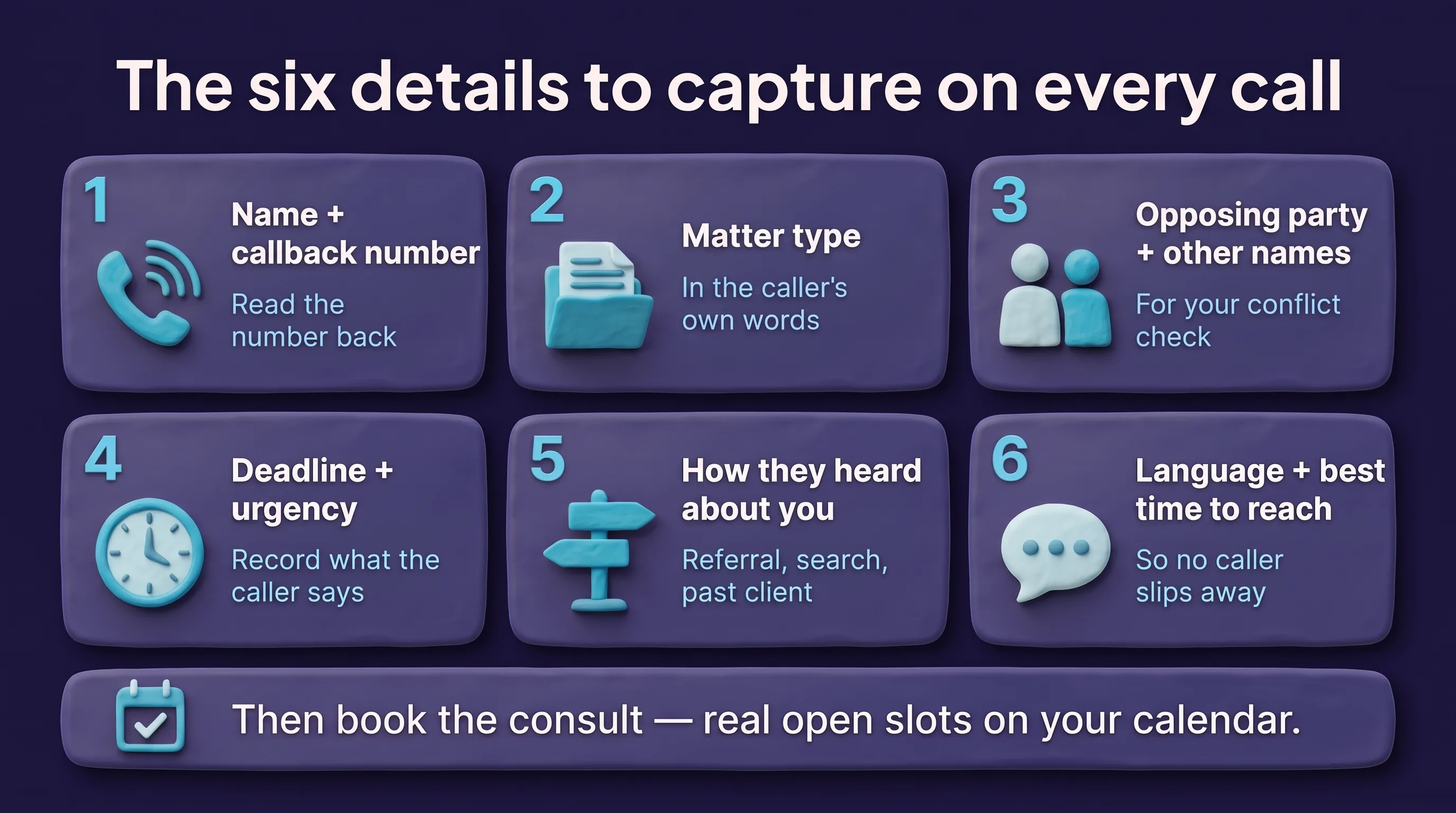
Use this checklist. If a service can’t do all six, keep looking.
- Name and callback number. The caller should hear the number read back. Wrong digits are the quietest way to lose a lead.
- Matter type. Capture the category in the caller’s own words, then map it to your practice areas. Callers rarely use your terminology, so the script should accept plain descriptions.
- Opposing party and other names involved. This is the conflict-check detail. Collect the full names of the other side and anyone else connected to the matter, and confirm spellings.
- Deadline and urgency. Record what the caller says about timing: a hearing date, a notice they received, or a situation happening now. The service records the caller’s statement. It does not judge how serious it is.
- How they heard about you. Referral, search, another attorney, or a past client. This is the cheapest marketing data you will ever collect, and it is usually skipped.
- Language and best time to reach them. A caller who prefers another language or only picks up on evenings is easy to lose without this.
Then comes the part that turns a message into a client: booking the consult. The service should offer real open slots on your calendar, not “someone will get back to you.” CallNeo integrates with any CRM that has an API, so bookings and intake notes can land where your team already works.
Why the opposing party matters
The answering service doesn’t run your conflict check. It collects the names so you can run it before anyone commits. Skip this field and your staff end up calling people back to ask, which is slower and looks less professional.
What must a legal answering service never do?
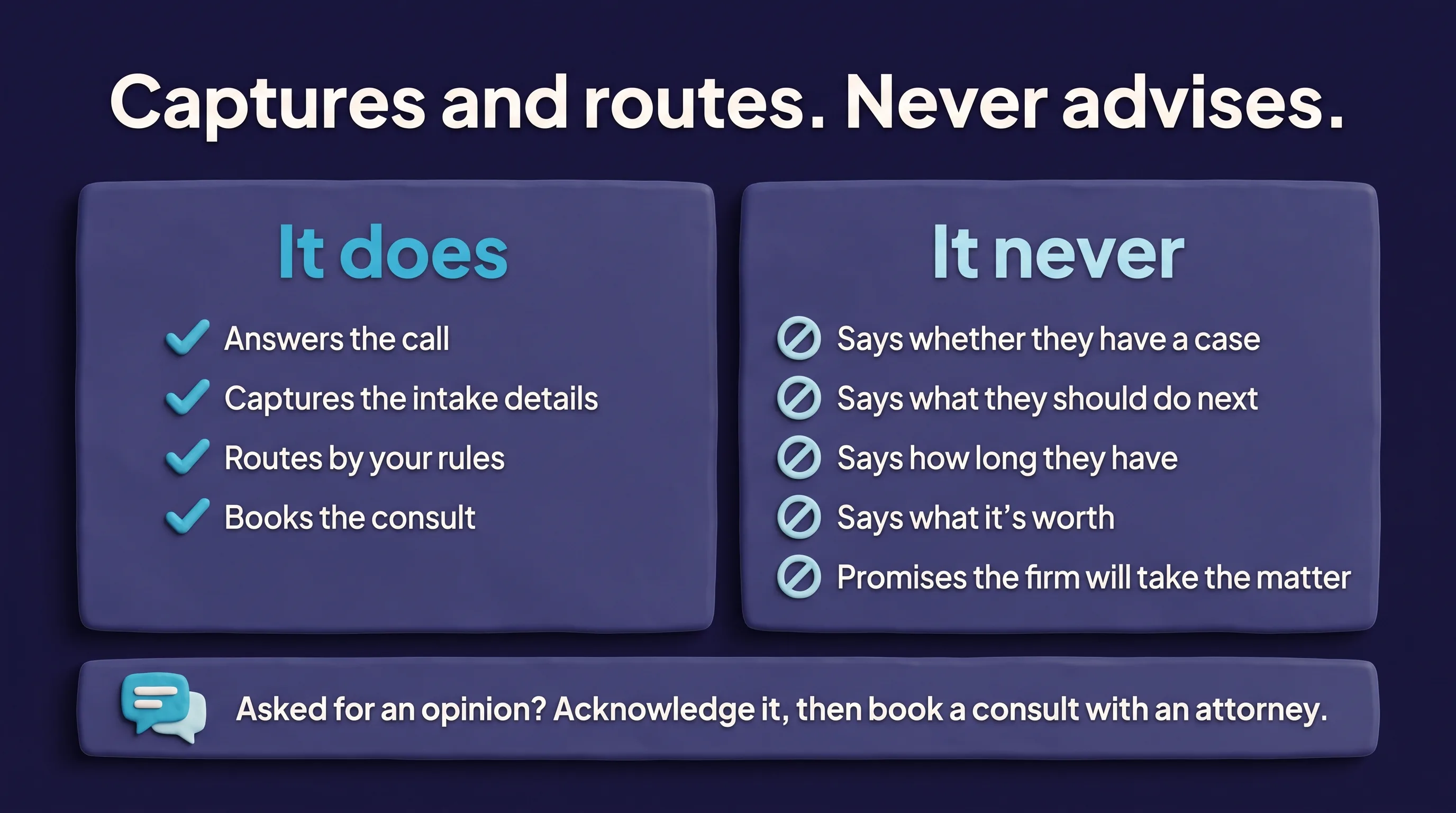
It must never give legal advice. That includes telling a caller whether they have a case, what they should do next, how long they have, or what their situation is worth. It also shouldn’t promise that the firm will take the matter or imply that an attorney-client relationship exists.
When a caller asks for an opinion, the right behavior is to acknowledge the question and move to booking a consult with an attorney. A well-built script does this every time. A tired human on the fortieth call of the night might not, which is a point in favor of scripted systems.
Some boundaries to check with any vendor:
- Urgency is routed, not assessed. If a caller says something is urgent, the service follows your rules: transfer to the on-call line, send an alert, or follow the emergency protocol you set, including directing true emergencies to 911.
- Disclaimer wording is yours. Your firm decides what a caller hears about the nature of the call. We put your language in the script. We don’t write legal policy for you.
- No compliance badges. CallNeo does not claim bar-rule compliance or any certification, and you should be skeptical of any vendor that implies it covers your ethics obligations for you. Confidentiality and ethics policies remain your firm’s responsibility.
How should a legal answering service handle after-hours calls?
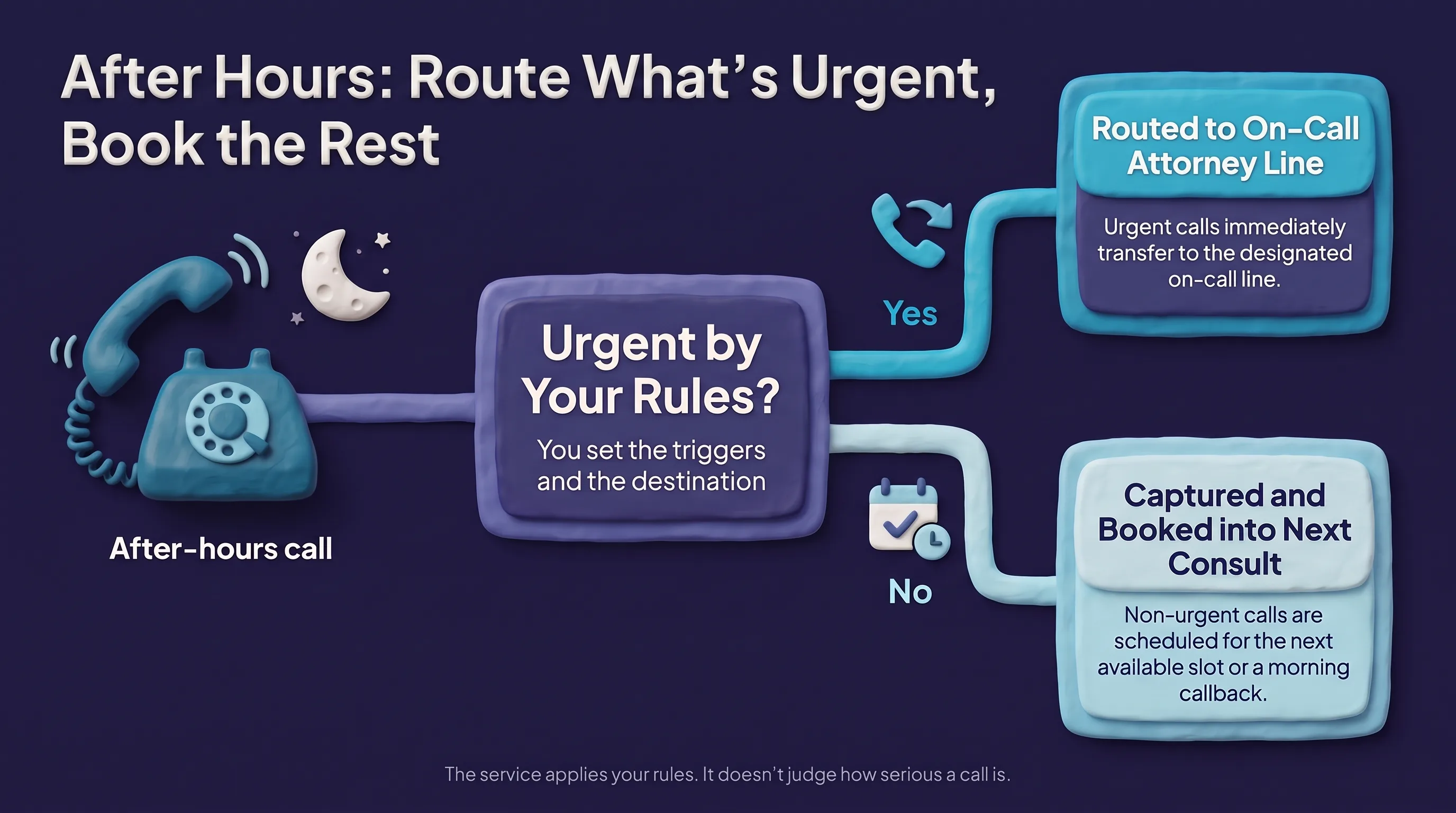
Trouble doesn’t keep office hours, so intake shouldn’t either. After hours, a good setup does two things:
- Routes what you define as urgent. You decide the triggers and the destination, such as an on-call attorney line. The service applies your rules.
- Books everything else. Routine inquiries get captured and offered the next available consult, or a morning callback.
You will see statistics online claiming that some large share of callers “never call back” after reaching voicemail. The “85% never call back” figure is one of them, and we’ve debunked it as untraceable. You don’t need a made-up number to make the case. A caller who is choosing a lawyer and reaches voicemail may simply try the next firm, and you can’t know which ones did. Our missed-call calculator lets you plug in your own numbers instead.
Does a legal answering service need to be bilingual?
That depends on your market. If a meaningful part of your inquiries come from callers who prefer another language, then yes, and it should be tested rather than assumed.
Ask any vendor, including us:
- Which languages are supported, in practice and not just on a features page?
- What happens when a caller switches languages mid-call?
- Can I hear a real sample call in the language I need?
- Does the intake checklist stay identical in that language, including the conflict-check fields?
We don’t list supported languages here, so confirm your language needs during scoping and on a test call before you commit.
Live vs AI legal answering service: which is better?
Neither wins everywhere. Here is the honest trade-off.
Where live people win:
- A caller who is distraught may want a human voice, and a person can sense tone in a way a script can’t.
- Unusual calls that don’t fit any script are easier for a person to handle gracefully.
Where AI wins:
- It answers every call, at any hour, without hold times.
- It asks the same questions in the same order every time, so intake is consistent.
For many firms the practical answer is AI for first contact and intake, with routing rules that send the right calls straight to a person. CallNeo is AI-first, not a human call center. If you want a human on every single call, that’s a different product.
How much does a legal answering service cost?
Pricing is the part buyers find hardest to compare, because vendors meter differently: by the minute, by the call, or by unique customer. The table below uses published plans only. None of these are legal-specific prices, and some vendors don’t publish overage.
| Option | Plan | Price | Included | Overage | Setup |
|---|---|---|---|---|---|
| CallNeo | Starter and up | From $95/mo | Varies by plan | Roughly $0.50 for a typical call | Done-for-you |
| Dialzara | Business Pro | $99/mo | 220 min | $0.45/min | Done-for-you |
| Smith.ai | Pro | $150/mo | 75+ calls | $1.60-$2.00/call | Dedicated onboarding setup |
| Ruby | 50 min | $250/mo | 50 min/mo | Not published | Guided onboarding |
| Ruby | 100 min | $395/mo | 100 min/mo | Not published | Guided onboarding |
Three things matter more than the sticker price:
- How usage is counted. A minute-based plan charges for the length of your intake calls. A per-call plan charges for volume. Know which one fits a firm where each call collects six fields. Intake calls run long, so this matters. CallNeo’s overage works out to roughly $0.50 for a typical call, so confirm how a long intake call is counted during scoping.
- What happens past the included amount. The overage column is where a quiet month and a busy month diverge. Ruby’s plans list overage as not published, so ask before you sign.
- Who builds it. A DIY tool is cheap until you’re the one writing and tuning an intake script. With CallNeo, we write the script, train it on your firm, connect your tools, and keep optimizing it.
CallNeo has no long-term contract, and most businesses are live in about 48 hours. For a deeper look at budgeting, see our AI receptionist cost guide. If you’re weighing a specific vendor, read our Smith.ai pricing breakdown or the direct CallNeo vs Smith.ai comparison.
What to ask before you sign with any legal answering service
Bring this list to every demo:
- Can I see the full intake script, including the conflict-check fields?
- What does it do when a caller asks for legal advice or an opinion on their case?
- How are urgent calls routed, and who decides the rules?
- What system can it send bookings and notes to?
- How is usage metered, and what does overage cost?
- Is there a contract, and what does it take to leave?
- Can I hear a sample call before I commit?
The last one is easy to test with us. Call the demo line to hear how an AI handles a call, or book a demo and we’ll walk through what intake would look like for your practice areas.
Frequently asked questions
What is a legal answering service?
A legal answering service picks up a law firm's phone calls when staff can't, captures structured intake details, and routes or books the caller according to the firm's rules. Good ones collect the caller's name and callback number, the matter type, the opposing and other parties involved, any deadline and urgency, the referral source, and the caller's language and best time to reach them. A legal answering service captures and routes. It does not advise.
What should a legal answering service never do?
A legal answering service should never give legal advice, assess whether a caller has a case, or promise that the firm will take a matter. Its job is to collect information and hand it to the attorneys. Urgent calls should be routed by the firm's own rules, such as an on-call attorney line, never judged by the answering service.
How much does a legal answering service cost?
Published plans vary widely. CallNeo, a done-for-you AI receptionist, starts at $95/mo, while the Ruby 50 min plan is $250/mo for 50 minutes and the Smith.ai Pro plan is $150/mo for 75+ calls. What you actually pay depends on call volume, how the vendor meters usage, and what happens after the included amount runs out.
Can an AI legal answering service handle after-hours calls?
An AI legal answering service like CallNeo answers 24/7, so after-hours callers reach an intake flow instead of voicemail. It captures the same details it would capture during the day. Urgent matters are routed by the firm's rules, for example to an on-call attorney line, and everything else can be booked into the next available consult.
Does an AI answering service replace a law firm's conflict check?
An AI answering service does not replace a law firm's conflict check. It collects the caller's name and the names of opposing and related parties so the firm can run its own check before anyone books or follows up. The conflict decision always stays with the firm.
What should a firm ask about bilingual legal answering?
A firm evaluating bilingual legal answering should ask which languages a vendor supports, how a call is handled if the caller switches languages, and whether the vendor will demo a real call in the language needed. Confirm this on a test call before signing, because language support varies by vendor and by build.
See CallNeo answer your calls
Book a 15-minute demo and hear exactly how CallNeo would handle your phones.