Comparison
AI Receptionist vs Answering Service

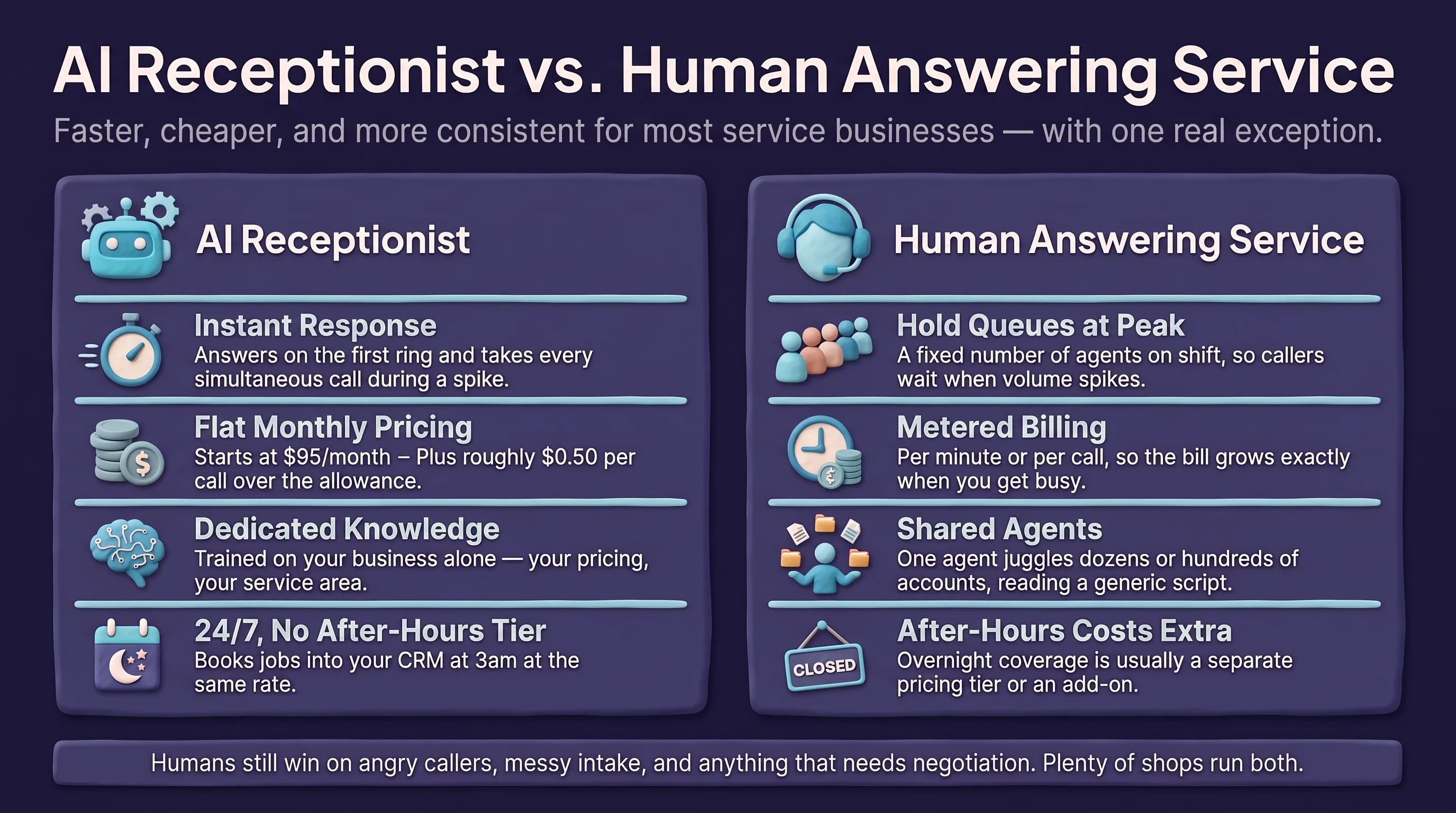
An AI receptionist answers every call instantly, 24/7, for a flat monthly fee — CallNeo starts at $95/month, with overage that works out to roughly $0.50 for a typical call. A traditional answering service staffs human agents and bills by the minute or by the call, so the bill grows exactly when you get busy. For most small service businesses, the AI receptionist is cheaper, faster to answer, and more consistent. The human service still wins on genuinely messy calls: complicated intake, upset customers, anything that needs judgment and negotiation.
That is the short answer. The rest of this post is the detail you need to actually make the call.
AI receptionist vs answering service: what each one actually is
An answering service (often sold as a virtual receptionist service) is a call center. Human agents sit at desks handling calls for dozens or hundreds of client businesses. When your line rolls over, an agent picks up, reads your account script off a screen, takes a message or does light scheduling, and passes it along. Pricing is almost always metered — per minute, per call, or per bundle of minutes with overage on top.
An AI receptionist is software. A voice agent answers your phone, follows a script built specifically for your business, answers real questions about your services and pricing, and writes the booking straight into your calendar or CRM. Pricing is usually a flat monthly plan with a call allowance.
The important distinction is not “robot vs human.” It is dedicated vs shared. A human agent at a shared call center is juggling many accounts and cannot know your business deeply. An AI receptionist is trained on one business — yours — so it can answer “do you service Hamilton County?” and “what does a water heater flush run?” without transferring anyone.
Which one answers faster?
The AI, and it is not close.
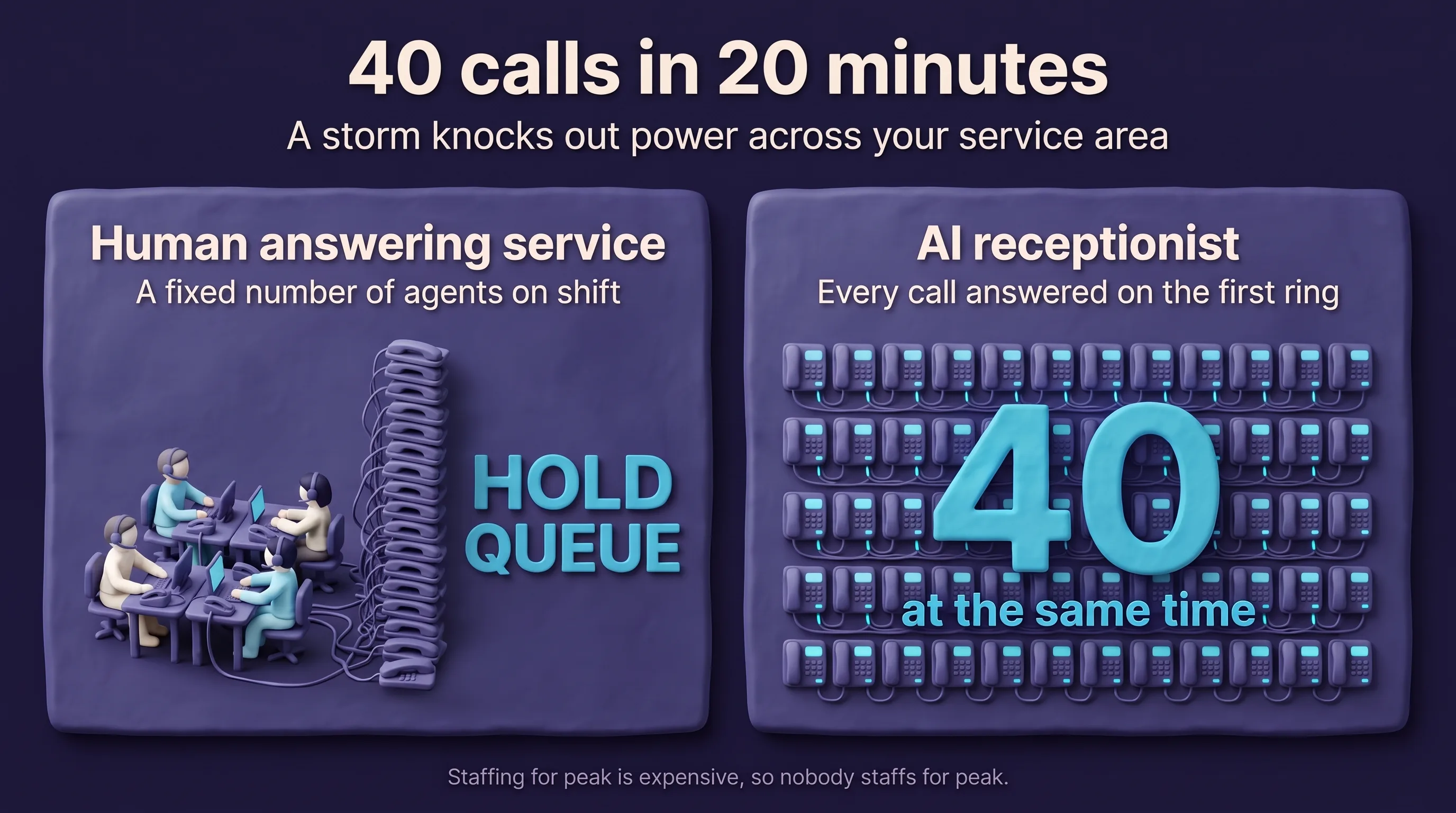
A human answering service has a fixed number of agents on shift. When a storm knocks out power across your service area and forty people call in the same twenty minutes, you get a hold queue. That is not a knock on the vendor; it is arithmetic. Staffing for peak is expensive, so nobody staffs for peak.
An AI receptionist takes every one of those forty calls at the same time, on the first ring. Concurrency is effectively free. For trades where call volume spikes hard and unpredictably — plumbing, HVAC, roofing — this is the single biggest practical difference between the two options.
It also matters at 11pm on a Sunday. Both options can cover after-hours, but with an answering service, overnight coverage is often a pricing tier or an add-on. With AI, 24/7 is just how it works.
Which one is cheaper?
Do this math with your own numbers, not a vendor’s.
Pull your last three phone bills or call logs and get two figures: total inbound calls per month and average call length. Then:
- Answering service cost = your monthly minutes × their per-minute rate, plus any base fee. Watch for billing increments — services that round up to the nearest minute, or bill a minimum per call, quietly inflate short calls.
- AI receptionist cost = flat plan + overage on calls above the allowance. With CallNeo, that starts at $95/month and overage runs roughly $0.50 for a typical call.
The pattern that usually emerges: at very low volume (a handful of calls a month) the two are close, because a metered service costs almost nothing when nobody calls. As volume climbs, the metered bill climbs with it and the flat plan does not. The crossover comes fast for most home service businesses.
There is a second cost line people forget: the calls you never got billed for because nobody answered them. If your service goes to voicemail during a hold queue, that is a real loss that never shows up on an invoice. Our missed-call revenue calculator puts a number on it using your own job value and close rate.
A note on the industry’s favorite statistics: you will see claims like “85% of callers never call back” or “a missed call costs the average business $126,000 a year” repeated across answering-service marketing pages. We went looking for the primary sources and could not find them — they trace back to other blog posts, not to research. We wrote up what we found. Missed calls do cost you money. Just build your business case on your own numbers, not on a stat with no origin.
For a full breakdown of what the AI side of the market charges, see our AI receptionist cost guide.
Where a human answering service genuinely wins
We sell AI, and we still tell some callers to stay with humans. Three situations:
1. Emotionally loaded calls. If a meaningful share of your inbound is angry, grieving, or in crisis, a trained human handles that better. Not marginally — categorically.
2. Intake that changes shape every call. Legal intake, complex insurance work, custom quoting that requires back-and-forth judgment. AI is excellent at structured conversation. It is weaker when there is no structure to follow.
3. A client base that will hang up on software. This is rarer than people assume, and it shrinks every year, but it is real in some markets. You know your customers better than we do.
A hybrid setup covers most of the middle ground: the AI answers every call and handles the routine majority — hours, service area, pricing, booking, rescheduling — and transfers the rest to a person on a rule you define. You pay human rates only for calls that need a human.
What about the AI receptionist that is just software you configure yourself?
This is the real fork in the road for an AI receptionist for small business, and it gets skipped in most comparisons.
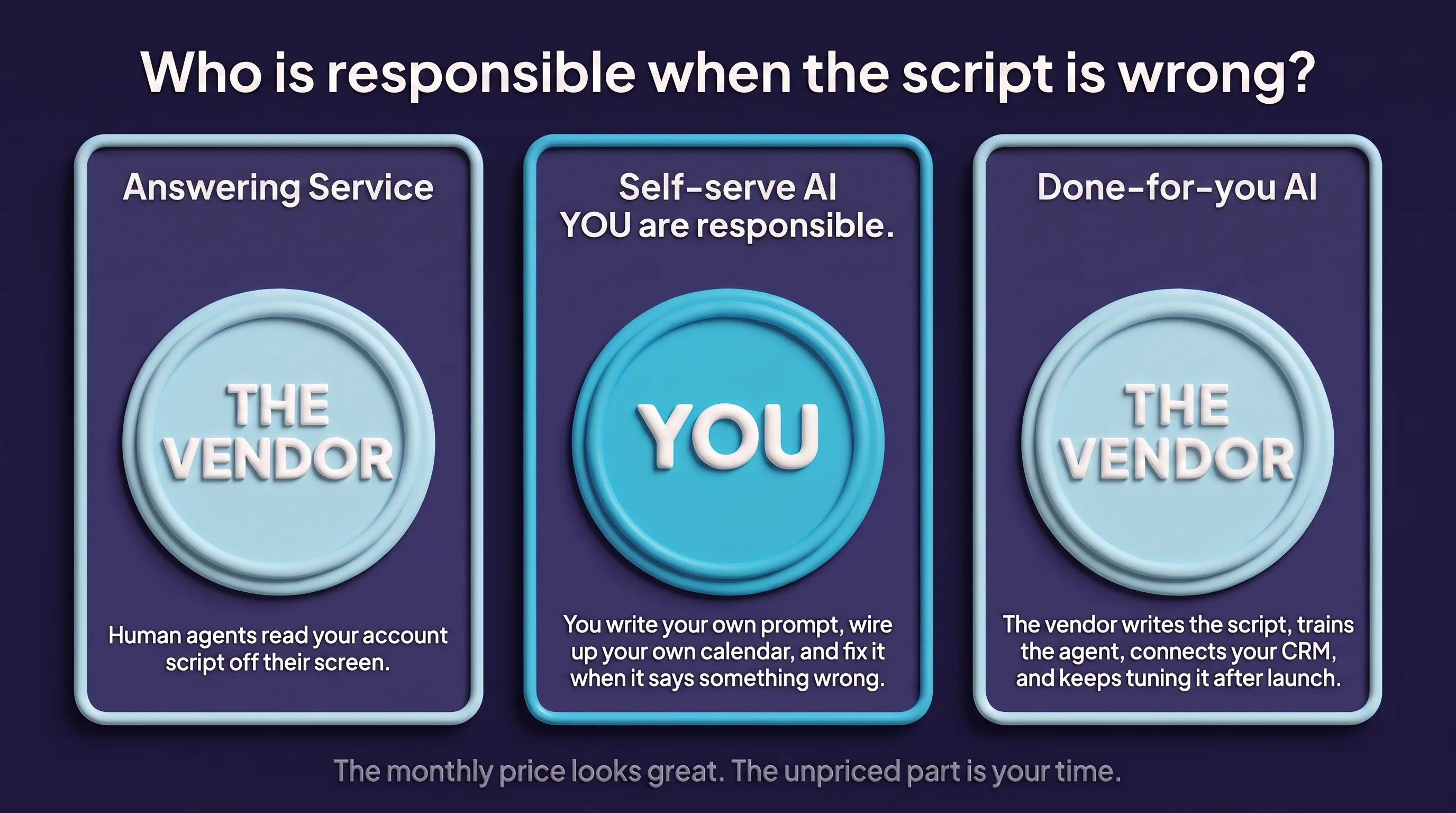
Some AI receptionist products are self-serve platforms. You sign up, get a dashboard, write your own prompt, wire up your own calendar, test it, and fix it when it says something wrong. The monthly price looks great. The unpriced part is your time — and prompt-writing is a skill most owners have no reason to have.
Others, including CallNeo, are done-for-you. We write the script, train the agent on your business, connect your CRM and calendar, and keep tuning it after launch. Most businesses are live in about 48 hours on the Starter plan. You only go live once it is ready.
If you are comparing across the whole category — humans, self-serve AI, done-for-you AI — the fairest test is: who is responsible when the script is wrong? With an answering service, the vendor is. With self-serve AI, you are. With done-for-you AI, the vendor is again. That single question sorts the market faster than any feature grid.
How do the two compare on emergencies and after-hours?
Both can handle it. The mechanism differs.
A human answering service follows your escalation instructions and calls or texts your on-call tech. An AI receptionist does the same thing, following rules you define during setup: what counts as urgent for your business, who gets woken up, and what the caller is told in the meantime.
The framing matters. The AI does not assess how serious a situation is on its own — it follows your protocol. If your rule says a gas smell means “tell the caller to leave the building and call 911, then page the on-call tech,” that is exactly what happens, every time, at the same speed at 3am as at 3pm. Human agents follow the same script but with human variance.
For healthcare and dental practices, there is an extra layer: CallNeo runs HIPAA-compliant infrastructure and signs BAAs with healthcare clients. Worth knowing — there is no such thing as being “HIPAA certified,” so if a vendor claims that badge, ask what they actually mean. Compliance is about infrastructure, agreements, and process, not a certificate.
What about hybrid services like Smith.ai?
Some vendors sit between the two categories, mixing human receptionists with AI. That is a legitimate model and it suits businesses that want a person on complex calls without hiring one.
The trade-off is usually price and pricing shape: human-in-the-loop models tend to meter your usage, because human time is the input. We put the details side by side in our CallNeo vs Smith.ai comparison and broke down how their plans are structured in Smith.ai pricing explained. Read both before you decide — we are not the right fit for everyone, and those pages say so.
A five-minute way to decide
- Count your calls. Last 90 days. Volume and average length.
- Sort them into three buckets. Routine (hours, location, pricing, booking), semi-complex (needs a lookup or a judgment call), and genuinely hard (angry, legal, emotional). If the routine bucket is over half, AI carries most of your load.
- Price both. Metered rate × your minutes vs flat plan + overage.
- Test the AI yourself. Call the CallNeo demo line and try to break it. Ask it something off-script. Book an appointment. It books a real one.
- Ask who owns the script. If the answer is “you do,” add the hours to your cost.
The bottom line
For a small service business with high call volume, predictable questions, and spiky demand, an AI receptionist wins on speed, cost, and consistency — and it never puts anyone on hold. For businesses with complex, emotional, or highly variable calls, human agents are still worth what they cost. Plenty of shops should run both.
If you want to see the AI side of the comparison firsthand, call the demo line or book a walkthrough. No contract, and we build it before you go live.
Frequently asked questions
What is the difference between an AI receptionist and an answering service?
An answering service uses human agents, usually shared across many client accounts, and bills by the minute or by the call. An AI receptionist is software that answers the phone with a voice agent trained on one specific business, and it typically bills a flat monthly rate with per-call overage. The AI answers instantly on every simultaneous call; a human service can put callers in a hold queue during a rush.
Is an AI receptionist cheaper than a live answering service?
An AI receptionist is usually cheaper than a live answering service, especially at moderate call volume. CallNeo starts at $95/month with overage that works out to roughly $0.50 for a typical call. Traditional answering services generally price per minute or per call, so your bill scales directly with how busy you get. Compare your actual monthly minutes before switching either way.
Can an AI receptionist book appointments on my calendar?
Yes. A properly configured AI receptionist writes directly to your scheduling system. CallNeo integrates with any CRM that has an API. CallNeo builds the integration for you during setup rather than handing you a dashboard to configure. You can call the CallNeo demo line and book a real appointment yourself to see it work.
Will callers know they are talking to an AI?
Many callers can tell they are speaking with an AI receptionist, and that is usually fine. What frustrates callers is a menu tree, a hold queue, or an agent who does not know the business. A trained AI receptionist that answers on the first ring, knows your service area and pricing, and books the appointment usually rates better than a generic call center script. You can also have it disclose that it is an AI assistant if you prefer.
What happens on an emergency call?
Emergency handling is routed by your rules. You define what counts as urgent for your business, and the AI follows that protocol exactly, whether that means transferring to your on-call phone, texting the tech on rotation, or instructing the caller to hang up and dial 911. The AI does not make clinical or safety judgments of its own.
Do I still need a human answering service for anything?
Sometimes. If your calls involve heavy negotiation, complex intake that changes shape every time, or a client base that will simply refuse to talk to software, humans still win. Many businesses run a hybrid setup: AI answers everything first and transfers the narrow set of calls that genuinely need a person.
See CallNeo answer your calls
Book a 15-minute demo and hear exactly how CallNeo would handle your phones.