Buyer's guide
What Is an Answering Service? (And Do You Still Need One?)

An answering service is a third party that answers your business phone when you can’t — taking messages, routing urgent calls, and often booking appointments. It can be staffed by live human operators, run by automated software, or handled by an AI receptionist. All three follow a script you provide. The difference is who or what is on the other end, and how much of the call they can actually finish.
That last part is the whole decision. A message-taking service hands you homework. A booking service hands you a filled calendar slot. Both get called “answering services,” and the price difference is often smaller than you’d expect.
What does an answering service do with a call?
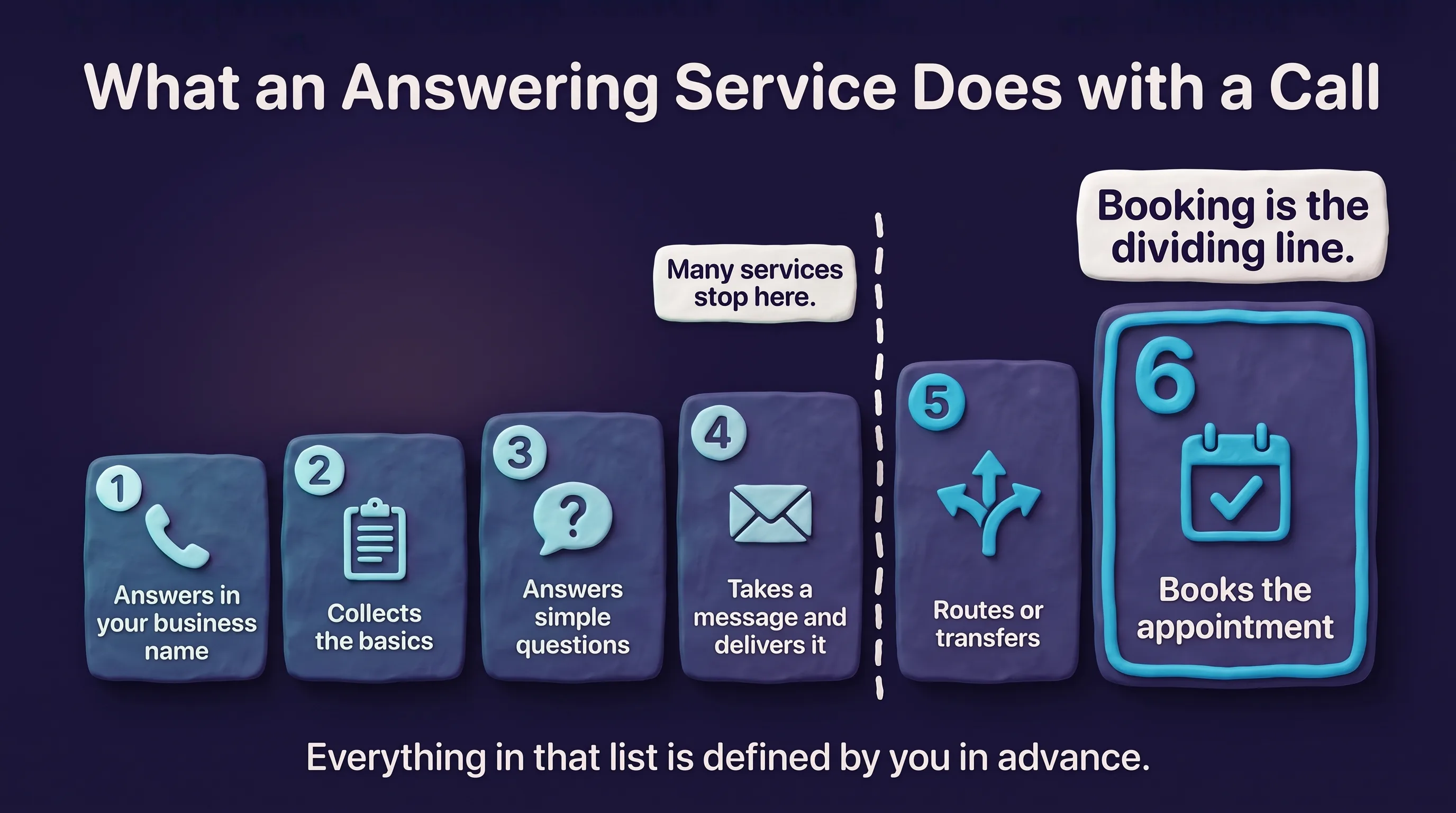
Strip away the marketing and every answering service does some subset of the same six things:
- Answers in your business name. “Thanks for calling Harbor Plumbing.” Not “answering service.”
- Collects the basics. Name, callback number, reason for calling, address if it’s a service call.
- Answers simple questions. Hours, service area, whether you take a particular brand or insurance, rough pricing if you’ve supplied it.
- Takes a message and delivers it. Text, email, portal, or a nightly summary.
- Routes or transfers. Live-transfers to you, or escalates to an on-call phone per rules you set.
- Books the appointment. This is the dividing line. Many services stop at step 4.
Everything in that list is defined by you in advance. An answering service has no independent judgment about your business — it has a script, a set of FAQs, and an escalation rule. The quality of the service is mostly the quality of that setup.
That’s worth sitting with for a second. When people are disappointed by an answering service, the usual cause isn’t the operator or the software. It’s that nobody wrote a good script, so the thing on the phone couldn’t answer the question the caller actually asked.
How does an answering service work, mechanically?
You forward your number. That’s it, from the caller’s point of view.
Behind the scenes you either forward all calls, or — more commonly for small businesses — you set conditional forwarding: ring your cell for 20 seconds, then forward to the service if nobody picks up. Some businesses forward only after hours. Some forward everything and use the service as the front door.
The service receives the call on your behalf, follows your script, and then delivers the output. Output is where providers diverge hard:
- Message only. You get a text with a name and number. You call back.
- Message plus context. Name, number, and a summary of what they wanted.
- Live transfer. The service screens, then patches the caller through to you if it qualifies.
- Completed action. The appointment is on your calendar, the lead is in your CRM, the job is dispatched.
Ask any provider which of those four you’re buying. The word “answering service” doesn’t tell you.
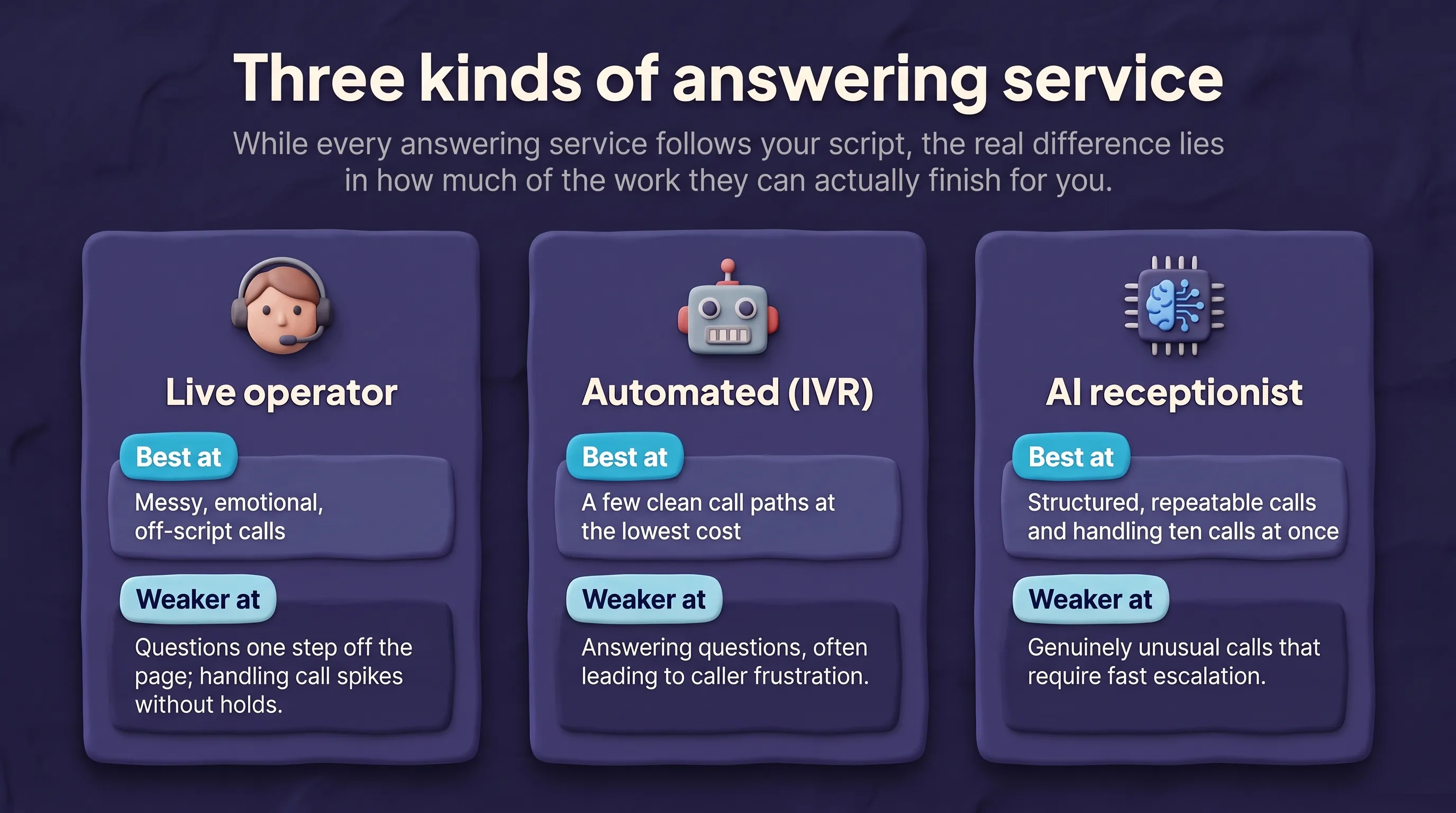
The three kinds of answering service
1. Live operator (human)
A real person in a call center picks up, usually working from a script on screen. They may be handling calls for dozens of businesses in a shift.
Where humans genuinely win: messy calls. A caller who’s upset, a heavy accent, a caller who won’t stay on topic, a situation nobody wrote a script for. A good operator improvises. Software doesn’t improvise — it follows rules. If a meaningful slice of your calls are emotionally loaded or unpredictable, a human is the right tool and you shouldn’t let anyone talk you out of it.
Where humans struggle: consistency and depth. The operator doesn’t know your business. They know your script. Ask them something one step off the page — “do you work on tankless units?” — and you get a message instead of an answer. Pricing is also usually per-minute, so a chatty caller costs you more than a quick one, and you can’t control which kind you get.
There’s also the hold problem. Live services are staffed to an average, not a peak. When three of your callers hit at once during a storm, someone waits.
2. Automated (IVR / voicemail-plus)
“Press 1 for sales, press 2 for service.” Or a recorded greeting that collects a voicemail and emails you the audio file.
This is the cheapest option and it’s not nothing — a clear IVR that routes to the right cell phone beats a generic voicemail box. But it can’t answer a question, and callers know it. Press-1 trees are the single most-disliked phone experience your customer will have that week, and a meaningful number of people just hang up rather than navigate one.
Automated systems fit businesses with a small number of very clean call paths and no need to answer anything. For most service businesses, that’s not the situation.
3. AI receptionist
A voice AI answers, holds an actual conversation, and — if it’s set up properly — finishes the call. Answers the FAQ. Confirms the service area. Books the slot. Writes the lead into your CRM. Escalates urgent calls by whatever rule you set.
Where AI genuinely wins: the structured, repeatable 80%. Hours, pricing ranges, “are you in my area,” “can someone come Thursday,” new-patient intake, quote requests. It handles ten simultaneous calls as easily as one, so nobody holds. It never has an off day. And because it’s software, it can be trained on your actual price sheet and service area rather than a two-page script.
Where AI is still weaker: the same place automation has always been weaker. The genuinely unusual call. A caller who’s crying. Someone whose accent or connection is fighting the transcription. A good AI setup handles this by escalating fast rather than pretending — but “escalates well” is not the same as “handles it.”
If you want the head-to-head in detail, we wrote it up separately: AI receptionist vs answering service.
What are 2 advantages of an answering service?
Since people search this directly, here it is plainly.
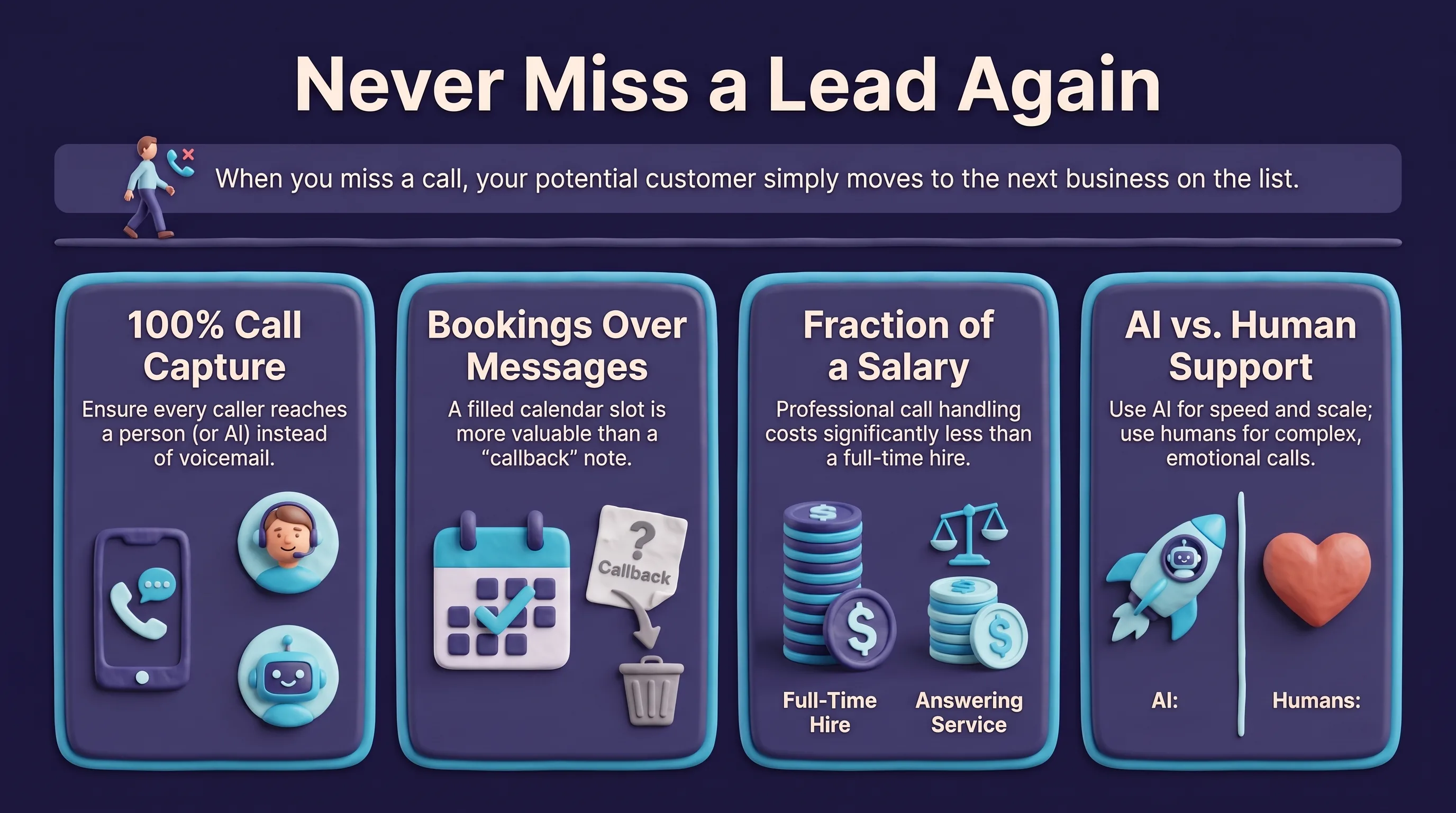
Advantage one: no call goes unanswered. Nights, weekends, lunch, mid-job, mid-procedure. Someone picks up. For a business where the caller is actively shopping — which is most home service and most healthcare — that’s the entire ballgame. A caller who reaches voicemail is a caller who is now free to dial the next name on the list.
Advantage two: it costs a fraction of a receptionist. You’re buying call handling, not a salary plus payroll tax plus benefits plus PTO coverage plus a desk. A part-time front desk hire runs into four figures a month before anything else. Answering services start well below that.
A third one worth adding, because it’s the one owners underrate: consistency. Every caller hears the same greeting, gets asked the same qualifying questions, and gets the same answer on pricing. You can’t get that from three different people covering the phone between jobs.
Do you still need one?
Not everyone does. Be honest about your numbers.
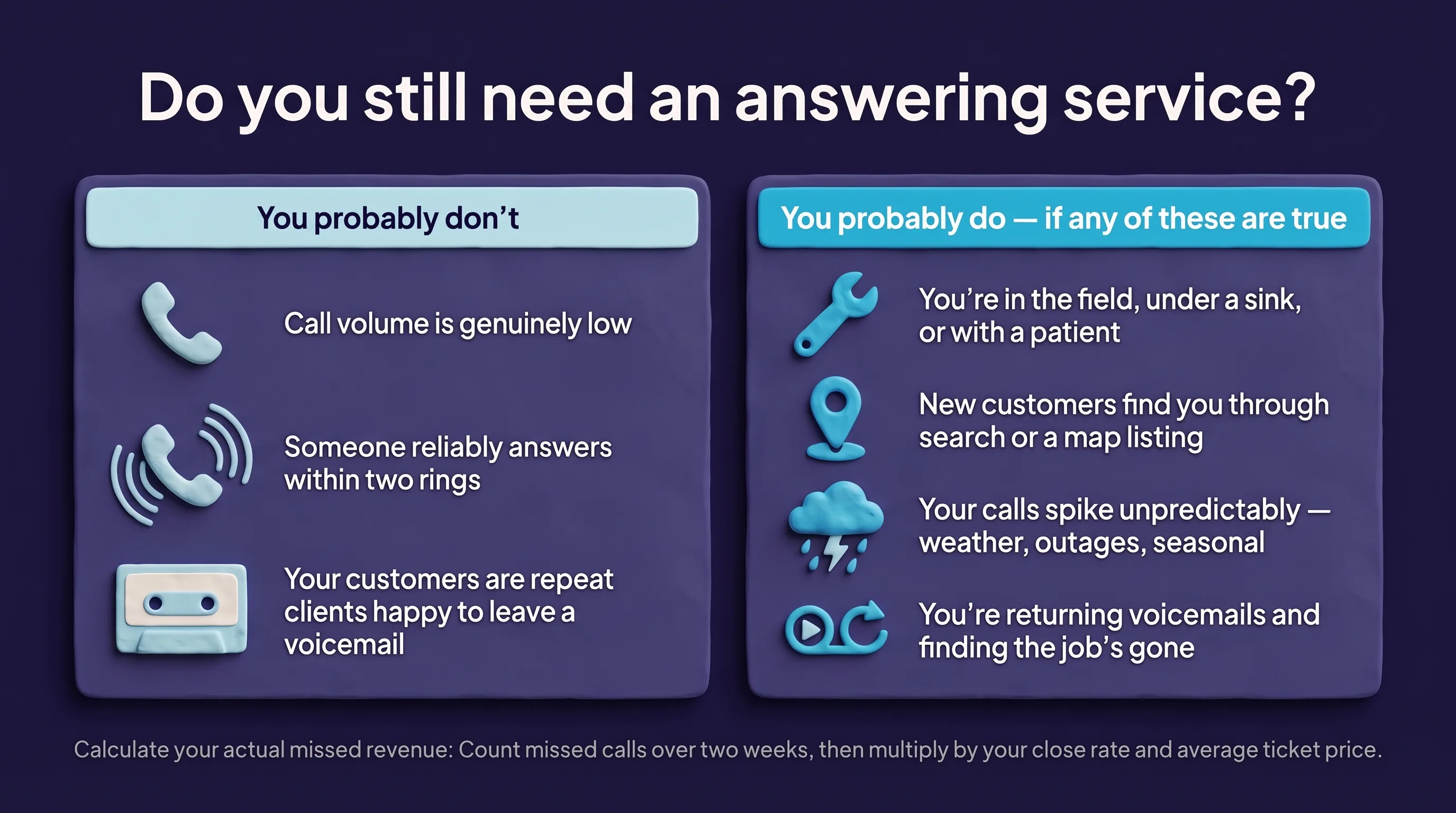
You probably don’t need one if: call volume is genuinely low, someone reliably answers within two rings during the hours your customers call, and your customers are repeat clients who’ll happily leave a voicemail. Some trades are like this. Plenty of B2B work is.
You probably do need one if any of these are true:
- You’re in the field, under a sink, or with a patient during business hours.
- New customers find you through search or a map listing, which means they’re comparison-shopping right now.
- Your calls spike unpredictably — weather, outages, seasonal.
- You’re already returning voicemails and finding the job’s gone.
You’ll see a lot of scare statistics attached to this question. The most common one claims 85% of people never call back after an unanswered call. We’ve gone looking for the source and it doesn’t exist — the figure is untraceable, and so are the “$126,000 in lost revenue” and “62% go to a competitor” numbers that travel with it. Don’t make a buying decision on a stat nobody can source.
Make it on your own numbers instead. Count your missed calls for two weeks. Multiply by your close rate and your average ticket. That’s the real figure, and it’s the only one that matters. Our missed-call calculator does the arithmetic, and we go deeper on the math in what missed calls actually cost a home service business.
How to choose between them
Four questions, in order:
1. What’s your call mix? Sort last month’s calls into “someone could have handled this from a script” and “this needed judgment.” If the first pile is most of it, AI or a well-scripted service will do fine. If the second pile is big, buy humans.
2. Do you want messages or outcomes? A message-taking service is cheaper and leaves the work with you. A booking service costs more and removes the work. If you’re the bottleneck, messages don’t help you.
3. How is it priced, and what happens at peak? Per-minute pricing means your worst month is also your most expensive month. Ask specifically how overage is billed. We break the whole category down in our answering service cost guide and the adjacent AI receptionist cost post. If you’re comparing against a specific incumbent, Smith.ai’s pricing is a useful reference point.
4. Who does the setup? This is the one people skip and regret. A service is only as good as its script and escalation rules. If the provider hands you a blank template and wishes you luck, budget a weekend. If they build it for you, that’s real value.
Where CallNeo sits
We’re the AI option, done for you. We write the script, train it on your actual business, connect it to your CRM — anything with an API — and keep tuning it after launch. From $95/mo, no long-term contract, answering 24/7. Most businesses are live in about 48 hours. Overage works out to roughly $0.50 for a typical call.
On urgency: we don’t assess anything clinically or legally, and no good provider should. Urgent calls are routed by your rules — 911, the on-call line, a direct transfer — exactly as your own protocol specifies. For healthcare clients we run HIPAA-compliant infrastructure and sign a BAA. Worth noting that “HIPAA certified” isn’t a real thing; if a vendor claims the badge, that tells you something.
And we’ll be straight about the trade-off: if most of your calls are unpredictable and emotionally heavy, a live operator is a defensible choice, and we’d rather you knew that before signing anything.
The fastest way to judge any of this is to hear it. Call our demo line and talk to an AI receptionist yourself — book a real appointment, try to trip it up, see where it holds. Then look at the industry pages for how we set it up for your trade, or book a demo and we’ll walk your call mix with you. We build it before you go live, and you only go live once it’s ready.
Frequently asked questions
What is an answering service?
An answering service is a third party that answers your business phone when you can't — taking messages, routing urgent calls, and often booking appointments. It can be staffed by live human operators, run by automated software, or handled by an AI receptionist. The service follows a script you provide so callers get a consistent answer every time.
What does an answering service do with a call?
It answers in your business name, collects the caller's name, number, and reason for calling, then acts on your instructions. That usually means sending you a message, transferring the call, booking an appointment, or escalating an urgent call according to rules you set in advance. Everything it does is defined by the script and protocol you hand it.
What are 2 advantages of an answering service?
First, no call goes unanswered — someone picks up nights, weekends, and while you're on a job, so callers aren't sent to voicemail. Second, it's far cheaper than hiring a full-time receptionist, because you pay for call handling rather than a salary. A third, less obvious advantage is consistency: every caller hears the same greeting and the same questions.
What is the difference between an answering service and a virtual receptionist?
In practice the terms overlap heavily and many companies use them interchangeably. Historically "answering service" meant message-taking and "virtual receptionist" implied deeper work like booking, transferring, and CRM entry. Judge a provider on what it actually does with a call, not on which label it uses in its marketing.
Is an AI answering service as good as a live operator?
For structured, repeatable calls — hours, pricing questions, booking, intake, routing — a well-trained AI handles them consistently and never puts anyone on hold. A live operator is still better for emotionally difficult conversations, heavy accents, and messy calls that go off-script. The honest answer is that it depends on the mix of calls your business actually gets.
How much does an answering service cost?
Live operator services are usually priced by the minute or by a monthly bundle of minutes, so your bill moves with call volume. AI answering services tend to price per month with a call allowance — CallNeo starts at $95/mo, with overage working out to roughly $0.50 for a typical call. Always ask how overage is billed before you sign.
See CallNeo answer your calls
Book a 15-minute demo and hear exactly how CallNeo would handle your phones.